
The 300 year old modern comic
Arguably the first great comic strip was painted in 1733. The hero ends up in a lunatic asylum, because of course he does.

If you prefer to listen to this, then please click here!
Before Action Comics. Before The Yellow Kid. Before the Penny Dreadfuls and the Illustrated Police News and the chapbooks and the broadsheets. Before any of it, there was William Hogarth, a printer’s son from Smithfield, standing in front of eight large canvases and essentially inventing modern comics, or “sequential art”, as the estimable Scott McCloud calls it.
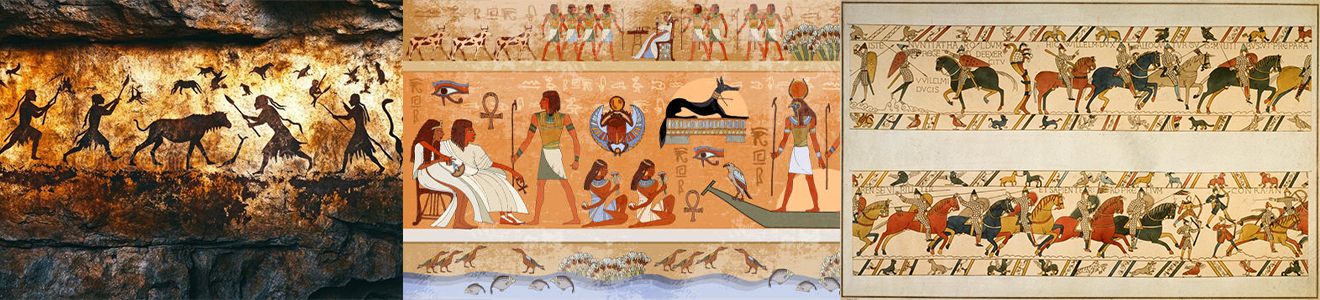
This was, to be clear, not the first example of sequential art: that can be seen in millennia old cave paintings, hieroglyphs or the Bayeux tapestry. And Hogarth, of course, didn’t call it that. He called it a “modern moral subject.”... But the structure is unmistakable: sequential images, a single protagonist, a beginning, a middle, a (catastrophic) end. Characters introduced, developed, and destroyed across a series of scenes that only work in sequence. Hidden details that reward careful readers. Satirical targets named, lampooned, and left for posterity to wince at centuries later.
The series was A Rake’s Progress. It was painted between 1732 and 1734, engraved and published in 1735, and it remains both high art as well as funny, bleak, and startlingly modern…
Who Was Hogarth?
William Hogarth was born in 1697 in the City of London, growing up in less than salubrious streets and visiting his father Richard in debtor’s prison… a biographical detail that he would later incorporate into his creations.
He trained as an engraver, taught himself to paint, and by his thirties had developed a completely distinctive approach to his art: sequential narrative paintings depicting contemporary London life in unflinching satirical detail, which he then had engraved and sold to the public as prints. Sets of these - his “modern moral subjects” - are the basis of what we now call comics.
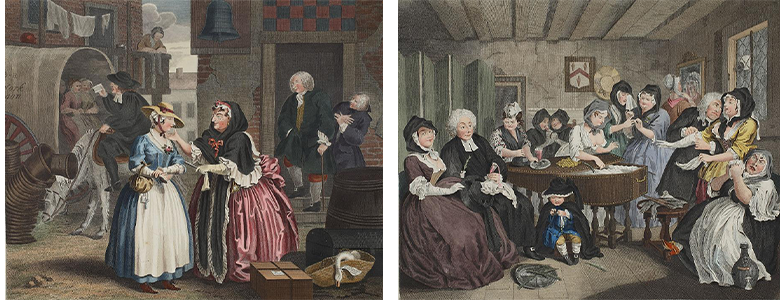
The first series, A Harlot’s Progress (1732), followed a country girl’s corruption and destruction in London across six paintings, the engravings of which sold more than a thousand sets almost immediately. The success immediately attracted pirates (apparently never a victimless crime, for those that remember the admonitions on DVDs…). Unauthorised copies of the engravings were flooding the market before Hogarth had recouped his costs on the originals.
His response was impressive and direct. He lobbied Parliament, successfully passing the Engraving Copyright Act in 1735 (often called the Hogarth Act for some strange reason) extended intellectual-property law from literature to the visual arts. He then withheld publication of his second series - A Rake’s Progress - until the Act had passed, ensuring legal protection before releasing the work. The man who invented the modern comic also invented artist copyright, although sadly that same battle was still being fought some 200 years later by Kirby and Siegel.
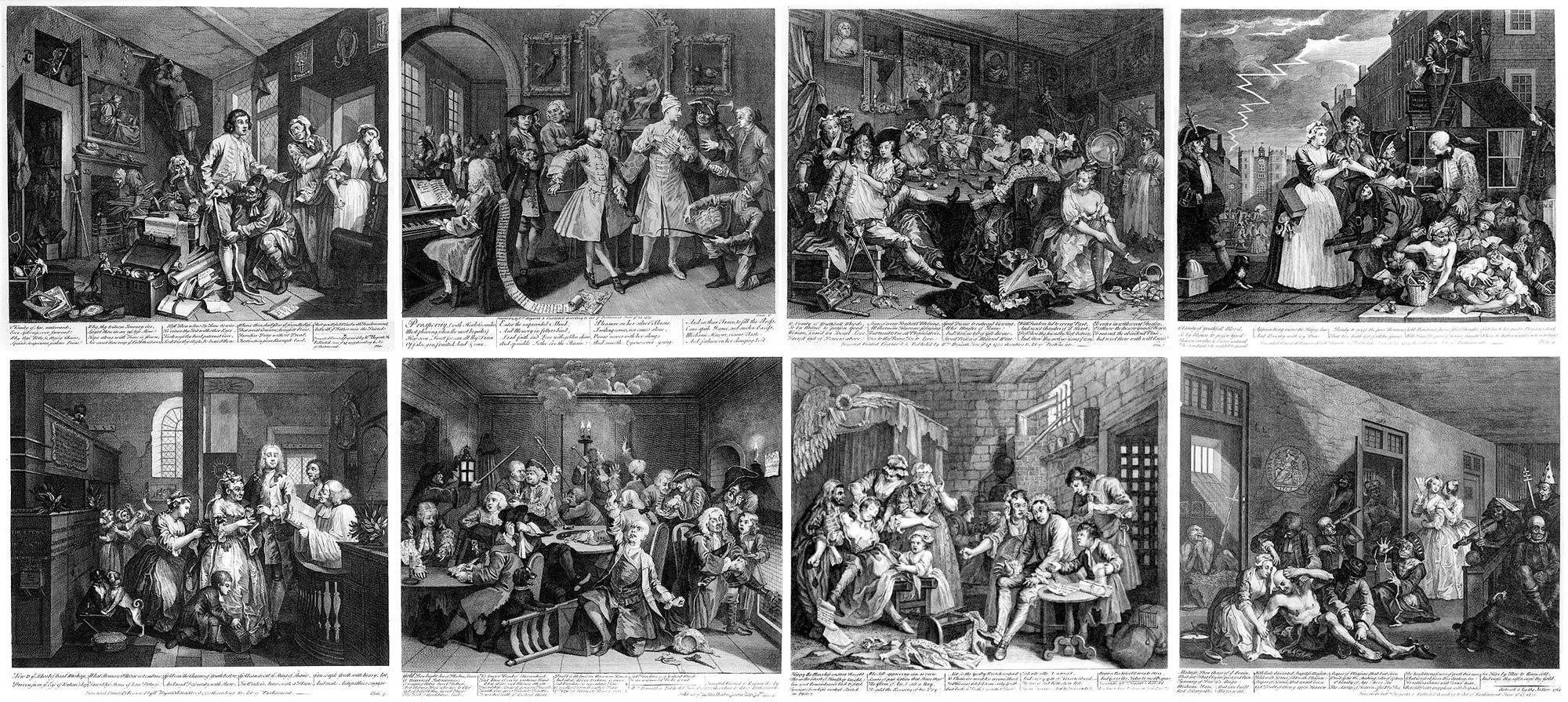
The Story (All Eight Plates)
The protagonist is Tom Rakewell. In Hogarth’s naming convention - which was later adopted by Dickens - the surname tells you everything (a rake being slang for a dissolute gentleman, and “well” ironically describing someone who is not). His foil is Sarah Young, whose surname signals her innocence and whose given name signals her ordinariness. She is the only genuinely good person in the story, and she suffers for it accordingly.
Plate 1 - The Heir
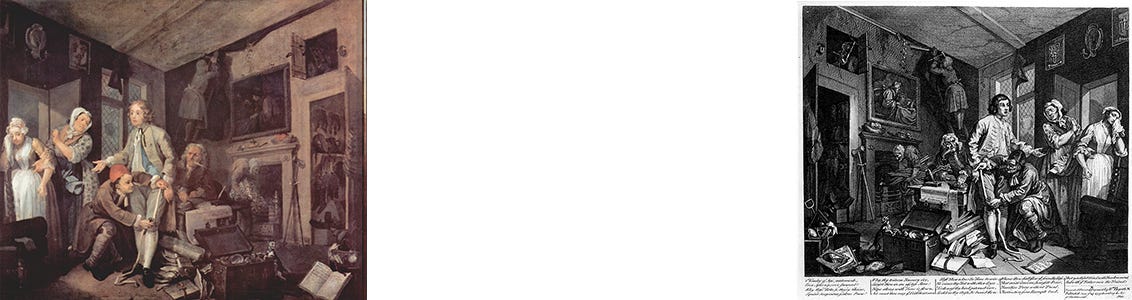
Tom - who has just inherited his miserly father’s estate - is being measured for new clothes while trying to bribe his pregnant fiancée (who he is planning to abandon) and her mother. A lawyer is discreetly pocketing coins from the inheritance in the background. Tom’s father’s worn possessions are visible throughout - including a starving cat - and everything we need to know about Tom is established in one image.
Plate 2 - The Levée
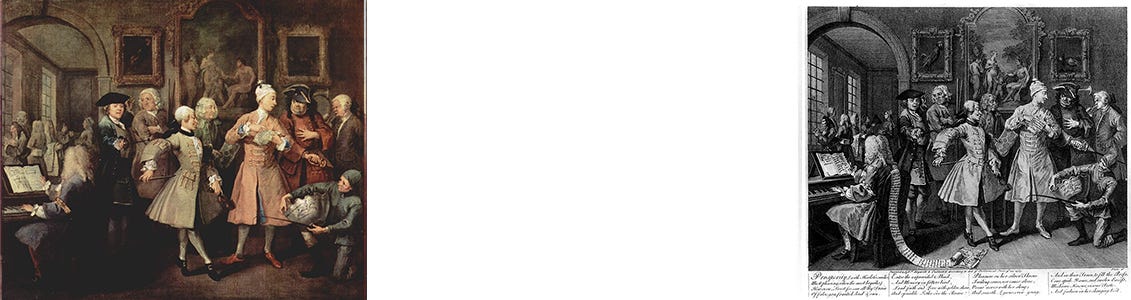
Tom has set himself up in fashionable London and is receiving morning visitors. The room is full of people who want something from him: a fencing master, a dancing master, a landscape gardener, a poet offering a dedication, a jockey carrying a silver trophy from Tom’s racehorse (named, delightfully,, “Silly Tom”). Everyone in the room is extracting money from Tom, who is too pleased with himself to notice.
Plate 3 - The Orgy / The Tavern
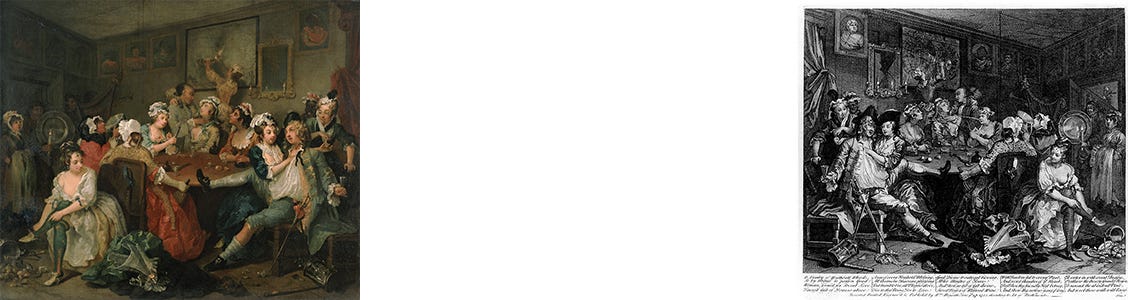
Tom is in a brothel in Covent Garden, specifically the Rose Tavern, which Hogarth’s contemporary audience would have recognised immediately. He is drunk, being entertained by one sex worker whilst another is stealing his watch, and both of them are showing signs of syphilis (the black marks on their faces are to cover syphilitic sores)... Hogarth is meticulous about the wages of specific sins.
Plate 4 - Arrested for Debt
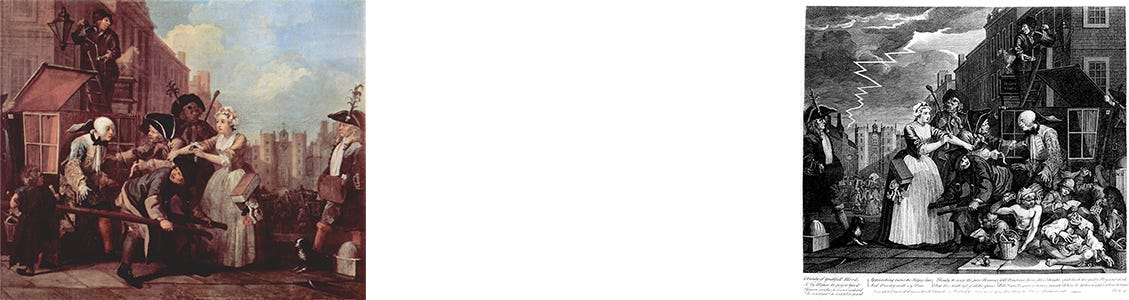
The money is running out, and Tom has been arrested for debt directly outside St. James’s Palace, a deliberate and pointed juxtaposition of power and its absence. The bailiffs have him, but Sarah Young intervenes. She pays the bailiff with what appears to be her own modest savings. Tom, characteristically, looks more embarrassed than grateful.
Plate 5 - The Marriage
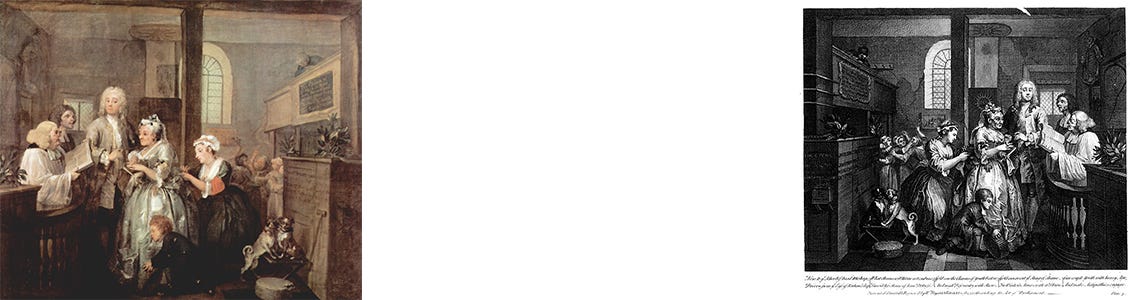
Desperate for money, Tom marries a wealthy older woman in a church near St. Marylebone. Sarah Young appears in the background, holding her (and Tom’s) child, being physically restrained from disrupting the service. Tom appears to be eyeing his new bride’s seamstress, whilst two dogs reflect the attitudes of those around them (enthusiasm and consternation).
Plate 6 - The Gaming House
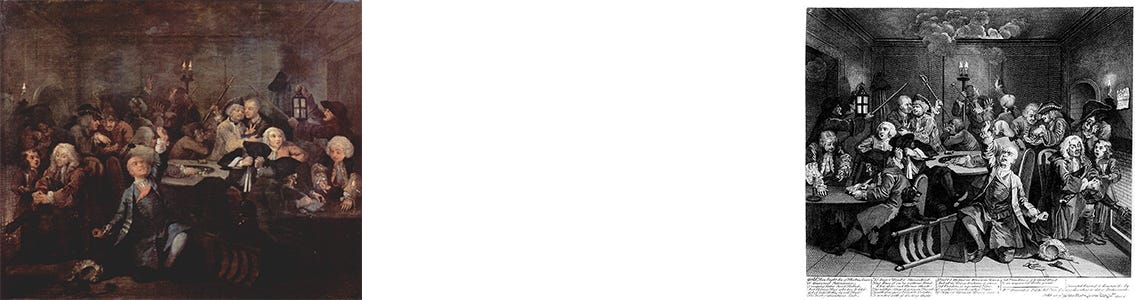
Tom is at White’s, one of London’s most fashionable gambling clubs, and he is losing everything (including his wig). The room around him is a catalogue of gambling-related misery, with men in various states of ruin (again showing Hogarth’s eye for satirical detail).
Plate 7 - The Prison
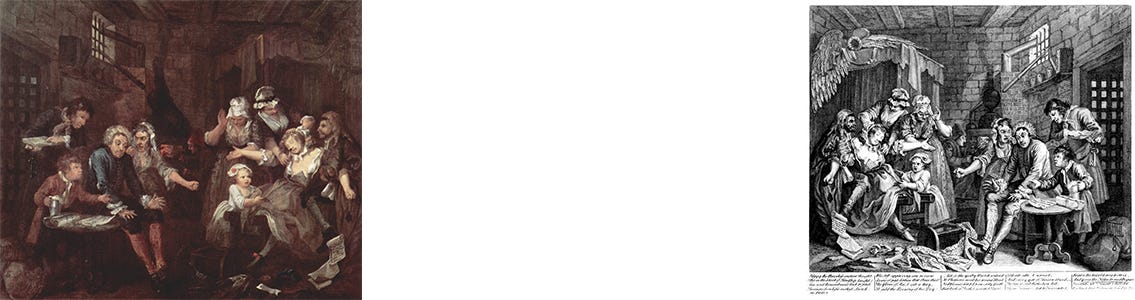
Tom is in the Fleet Prison for debtors, somewhere he was familiar with from his father’s time there. His elderly wife is present, furious, whilst Tom is pestered by people seeking money from him (I particularly like the young child holding a mug of beer). Everything is grimy and crowded and - as always - specific.
Plate 8 - Bedlam - The Madhouse
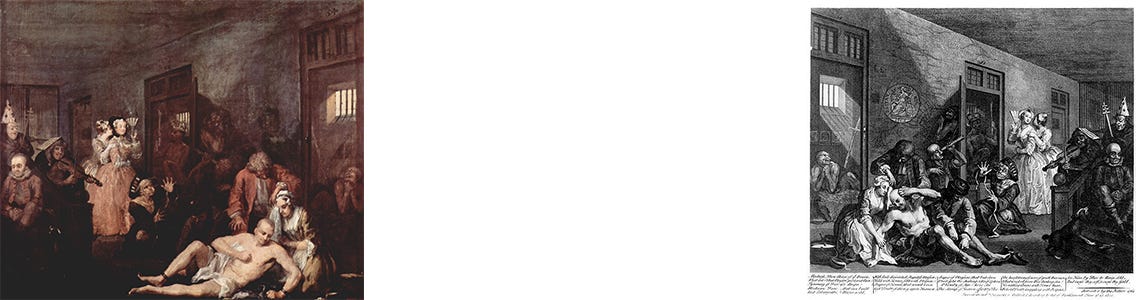
The final plate, and Tom is in Bethlem Royal Hospital - Bedlam, the original madhouse. He has lost his mind completely, which is a possible side effect of syphilis that he contracted many months (or years) ago. Sarah Young is there for the last time, weeping over him, while in the background wealthy Londoners are touring the asylum as a leisure activity (Bedlam was a popular tourist attraction in the 18th century, admission one penny) observing the inmates with a mixture of amusement and detachment that Hogarth seems to find as damning as anything Tom has done.
It is, in the original meaning of the word, a tragedy. It is also completely, mordantly funny.
Why This Matters (For Our Purposes)
William Hogarth’s narrative series used panel-like composition and sequential storytelling, showing that comics’ potential for social critique and thematic depth has long historical roots.
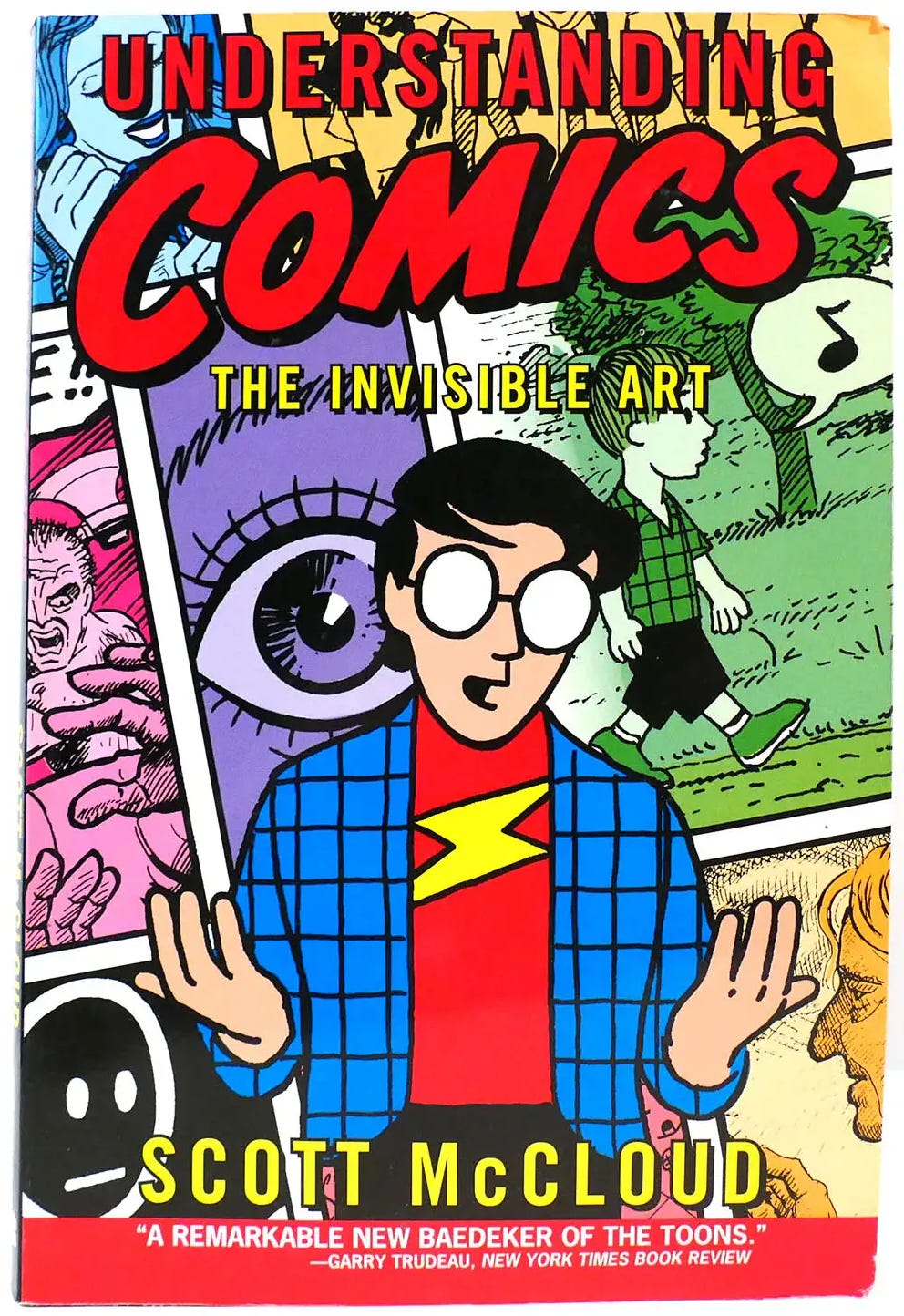
Scott McCloud’s Understanding Comics (1993) - the definitive theoretical text on the medium - cites Hogarth explicitly in its first chapter, tracing the lineage of sequential art directly through his work.
The influence runs forward through the political cartoonists of the 19th century - James Gillray, George Cruikshank - who took Hogarth’s satirical visual language and applied it to Bonaparte and the Prince Regent with the same gleeful viciousness. Through the illustrated novels of Cruikshank’s friend Dickens, where the character naming convention Hogarth pioneered (Tom Rakewell, meet Mr. Gradgrind) found its literary home. Through the newspaper comic strips of the 1890s, the comic books of the 1930s, and the graphic novels of the 1970s.
The original eight paintings of A Rake’s Progress are in Sir John Soane’s Museum in London, where they have been since 1802. They are among the most visited objects in a museum full of remarkable things, so if you’re ever in London, go. Take your time with each panel. Look for the dog.
Kickstarter Spotlight

Black Noir is an anthology series based on the genre created in the 60s, featuring both individual episodes of series in an individual issue, plus collected editions of complete stories. Find the link to it below:
From Our Vaults:
We’re building a collection of amazing pre-code books of every stripe, so this week we’re looking at the weird and wonderful…

There’s an array of new pre-code books on the site, and more are added every day, covering genres from Horror, Good Girl, War, Sci-Fi, Fantasy, Romance and more!
That’s it for now! I trust you enjoyed today’s look back in time… next week we will be looking at something a tad more modern… which isn’t hard, I realize, give the throwback that this was!
Have a great week, and as always
Keep Buggering On.
Adam & Team Macroverse